
Equal Consideration
The mandatory consideration of the real parameters of human life when a system is designed and a decision is made.
We use analytics cookies to understand how the site is used. They stay off unless you accept them. Cookie Notice



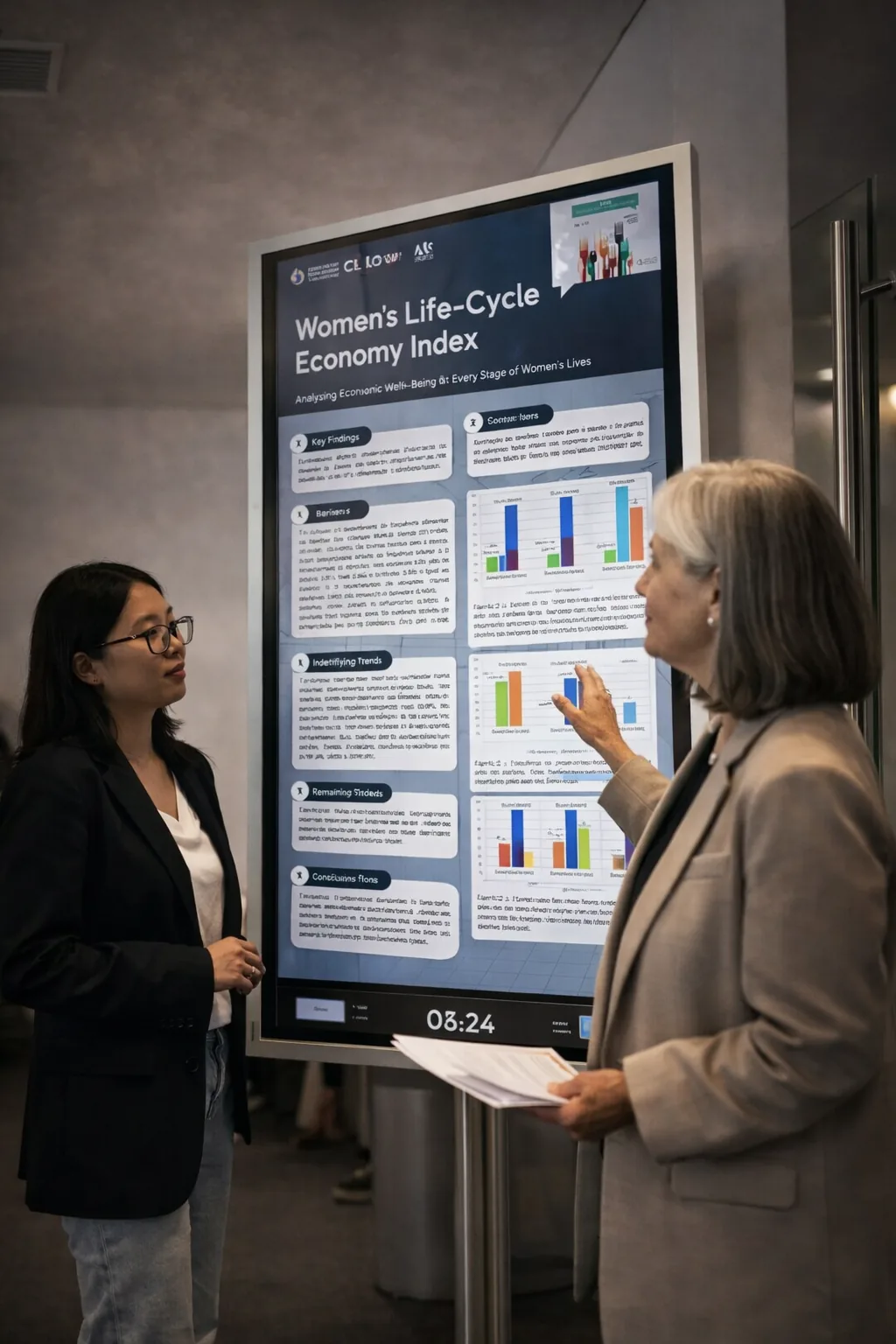
Women's Life-Cycle Economy Index
What the WLCE Index measures, how data is collected and how participants are protected
This page collects the main terms of the Women's Life-Cycle Economy Index: original concepts and the terms of the Index and the research, explained without specialist training. The four original terms were created in English, and their English names and definitions are canonical. The definitions describe a program in development; the readiness of documents is shown on the status page and in the Index Results Register.
The system of four terms with their definitions was developed by Marina Sukhomlinova, Founder & President, Womafreesm. The terms were created in English: the English names and definitions are canonical, and each language version of the site places its translation next to the English name.
Non-take-up means that people entitled to a social benefit or service do not receive it; its causes can lie in information, conditions for applying, administrative procedures and other barriers. In the WLCE Index, the term Silent Denial describes the gap between a provided entitlement and what was actually received, and the analysis looks at four links: recognition, entitlement, operational capacity and take-up.
The mandatory consideration of the real parameters of human life when a system is designed and a decision is made.

A point in a woman's life cycle where the system did not see her when it designed the rule. The unit of observation of the WLCE Index.

How far an institutional rule falls short of the benchmark before anyone tries to use it. The rule itself was designed for less than a whole life.

The entitlement exists, the woman did not receive it, and no refusal was ever issued. Measured as the signed distance between what the rule provides and what was received, attributed to the link where the loss occurred: recognition, entitlement, operational capacity, or take-up.
The unit of the Index: a comparison of what an institutional rule provides with what happens in the lives of the women it applies to. The rule itself is also compared with a benchmark of full consideration set in advance. The Index measures this comparison, not women's answers or the text of a law on their own.
A description of what a rule provides for a woman: which rights or opportunities, for whom, under what conditions and for how long. Each measure states its document, source and date.
What happened to the woman who went through the decision: whether she knew about her entitlement, whether she could use it, what it cost her.
The action a system performs in a particular life situation: it grants access, allocates a resource, compensates for losses, protects, or recognizes a right. Recorded for every paired measurement, because the same topic produces different failures depending on the action.
A stage of life or a life transition in which the rule's effect is examined: pregnancy, birth, recovery, care for children and older relatives, career pause, return to work, perimenopause and menopause, later life, migration. Several of these circumstances can coincide. One of a record's three coordinates, with the system and the decision function.
Where the rule operates: the labor market, healthcare, social protection and pensions, law, finance and insurance, AI and digital systems, the market. The second of a record's three coordinates.
A description of a single measure: what it measures, which group of women it concerns, what data it uses and how it is calculated. The card also holds the benchmark and its source, the missing-data rule, the life stage, the system and the decision function. A measure enters the calculation only when every field is filled.
The group of women for whom a particular measure is calculated. Its make-up is set by the life circumstances, the decision studied and the observation period. For a measure of the use of parental leave, for example, the child's age, the period and the conditions the question refers to are set in advance.
The standard against which full consideration is defined for a paired measurement, taken from an international document that justifies it, for example ILO Convention 183 on maternity protection. Fixed before data collection.
The structure that links the stages of women's lives with decision systems and shows which rules and results are studied at each intersection. The nine sub-indices are calculated from it.
An aggregate measure for one of the nine areas of the WLCE Index, combining the paired measurements that belong to that area under the rules of the methodology: care load, health visibility, career cycle, economic loss, age relevance, AI misclassification, market recognition, institutional fit, Equal Consideration readiness.
The values that give the scale its meaning: 100 corresponds to full consideration against the set benchmark, 0 to a systemic blind spot. Missing data is marked separately. Comparability between editions also depends on the set of measures and the calculation rules.
A threshold set in advance for a critical measure. A result below it gets a separate mark next to the country's overall score, so the problem stays visible even when other areas score high.
The main product of the first edition: where in the life cycle, in which system and on which function a woman drops out of the calculation, country by country.
The range of positions a country takes under the tested variants of calculating the Index, for example with different weights. It shows how far the country's position depends on these assumptions and is published instead of one exact position.
The share of tested calculation variants in which a country falls into a given group of countries. It is a frequency across calculation scenarios, not a probability in the strict statistical sense.
Registering the research and analysis plan with a fixed date before the relevant stage begins, so that one can check which decisions were made in advance and which after seeing the results. The pilot protocol and the preliminary formula are fixed before the pilot; version 1 of the methodology, prepared after the pilot, is fixed before the first global wave.
The procedure for changing the methodology between editions. Every change gets a version number, a date and a public explanation.
Eight planned checks by which the readiness of the methodology for the first global wave is assessed. The criteria and thresholds will be published before the pilot begins; the results will show what is ready and what needs more work.
Open-survey questionnaires that passed quality checks. They help study the diversity of experience, rare situations and particular groups of participants. A country's position is not determined from them.
The planned 2,000,000 questionnaires that passed quality checks, across all collection paths: the open survey, the random samples and the repeat waves. The number of women who answered is counted and published separately, since one woman may answer in several waves.
The WLCE Index result for a country, calculated from institutional measures and data on women's experience. The survey part used to compare countries rests on that country's random sample. The methodology sets the conditions for including a country in the comparison.
A sample from a defined group of a country's women, in which participants are selected at random with known, nonzero probabilities of inclusion. Selection follows the program's scheme, independently of open invitations; a partner organization may also conduct its interviews under the sample protocol.
A survey in which women aged 18 and over take part by their own decision, within the conditions of the research. The probabilities of inclusion in it are unknown. Its results help study participants' experience and find situations for further research; the survey part of a country estimate rests on the random sample, however large the open survey is.
The chance of being selected into a sample under a set selection procedure. In a random sample it can be determined from the selection rules; in an open survey it is unknown.
The size of a simple random sample that would give the same precision for a particular measure as the actual sample with its selection method and weights. Published for every country.
How many times the selection method and weighting change the variance of an estimate compared with a simple random sample of the same size. A value above 1 means less precision, below 1 more.
A statistical adjustment of how much answers contribute to the overall result, taking into account selection probabilities and the make-up of the sample. The answers themselves do not change. Weighting helps account for differences in how groups are represented but does not guarantee that every bias is removed.
The questionnaire of a participant aged 18 or over who gave consent and reached the end of the main questionnaire, which passed quality checks, including checks for duplicates, bots and fraud. Skipping individual questions does not make it unusable.
A participant's decision not to answer the block of sensitive questions. It is recorded separately as her decision and does not by itself make her other answers unusable; the absence of these data is taken into account in the analysis.
Collecting answers without a woman filling in an online questionnaire herself, for example in a face-to-face interview through partner organizations, women's associations, clinics and local venues. For each such collection, how participants were selected is stated separately.
A list, register or set of territories from which random selection is made. For each frame, the groups it covers and those it leaves out are stated. A partner organization's membership list can be a frame for its members, but not for a country's women.
A questionnaire in one language for one country and one way of conducting the survey, tested separately. The unit of translation work.
Checking with women in a country whether a question is understood as intended, before it is used.
A participant decides separately whether to take the main questionnaire, whether to answer the sensitive questions, and whether to allow repeat contact and additional uses of the data. How these decisions depend on each other is explained in advance; declining the additional options does not by itself prevent taking part in the main questionnaire.
A separate block of questions about violence, experience of seeking medical care, control over money, harassment and threats to safety. It has its own consent, its own data class and special access rules.
A list of help services in a country with contacts, conditions for turning to them and the date of the last check. An up-to-date map is a condition for asking about violence at all.
Written instructions for when taking part causes strong distress or a safety threat arises: how to pause or end the survey, offer information about help and act within the team's remit.
The information that allows a participant's code to be matched with her identity or contact details. The program provides for storing it separately and limiting access to it: the key can be applied only by two people together.
Data in which direct identifiers such as names and contact details are replaced by codes, while the information needed to establish identity is stored separately. In the research such records are handled as personal data.
Data from which a person cannot be identified by means reasonably available in the circumstances, including by matching with other information. Removing a name or the linkage key is not by itself enough to treat data as anonymous.
A restricted-access system in which approved researchers analyze participants' data. Records stay inside, and results that leave it are checked for the risk of disclosing personal information.
The body provided for by the program that reviews requests for access to individual participants' data under rules that are the same for everyone.
The contract a researcher signs: no re-identification, no unapproved linkage, no local download, output check before release.
A check of summary results before publication for the risk of revealing a participant's identity or information about her. It takes into account small groups and the possibility of matching several tables; where needed, results are combined into larger groups or individual values are withheld.
An assessment, made in advance, of what risks collecting and using the data create for people, how serious they are and what measures are needed to reduce them.
A standard Womafreesm is developing for designing and checking decisions that affect women's lives. Its requirements will rest on the results of the WLCE Index pilot.
A planned procedure for assessing an organization against the Equal Consideration Standard at its own request. The organization provides evidence that is checked against published criteria; the result is published in an open registry. The procedure, levels and conditions of participation will be set by the Standard's documents.
Data: what is known about women's lives. Design of the decision: how that knowledge is built into the rules. Consequences: what happens once the decision is applied. Accountability: who answers for the result and for fixing the problems found. Each area needs evidence.
The levels provided for in the draft Standard: Awareness, Diagnostic, Pilot, Institutional adoption, Public accountability. The criteria for each level will be set by the Standard's documents.
A principle of the Standard: assessing conformity and helping with implementation are done by different people, and the assessor does not sell the fix. The rules for appointing assessors and for the work of consultants will be set as the Standard's procedures are developed.
Select your Telegram language